
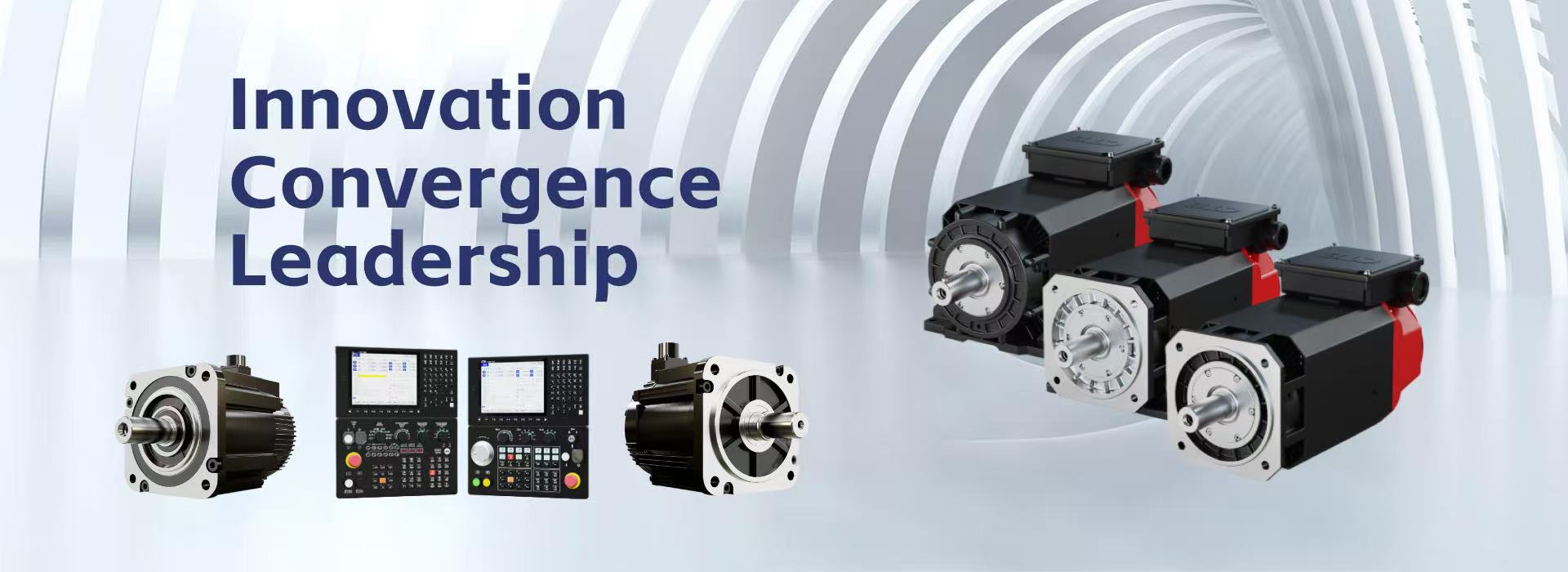
If we compare an industrial robot to a human being, then sensors are its “eyes”, the controller is its “brain”, and the servo motor is the precise, powerful and obedient “muscle”.
In modern intelligent manufacturing, the word “servo” comes from the Latin word “Servus”, meaning “slave”. As the name suggests, a servo motor is a type of electric motor that strictly follows control signal commands to achieve precise control over position, speed and torque.
I. The “Iron Triangle” Structure of Servo Motors
An ordinary electric motor (such as the induction motor in a fan) simply runs continuously once powered on, and it is nearly impossible to make it stop precisely at 89.5 degrees. A servo motor, however, is different: it operates as a closed-loop system, typically composed of three core components:
Motor Body (The Muscle)Converts electrical energy into mechanical power.
Sensor / Encoder (The Eyes)Mounted at the rear of the motor, it records in real time how many revolutions the motor has turned and its exact position, then feeds this information back to the controller.
Drive / Controller (The Brain)Receives external commands, compares the feedback signal with the target instruction, and adjusts the output current through control algorithms to correct any deviation.
II. Working Principle: A “Closed-Loop Dialogue” Between Conductor and Performer
The core advantage of servo motors lies in closed-loop control.
Open-loop control (e.g., stepper motors):The conductor calls “move three steps forward”, and the performer attempts to do so. But if the performer slips and fails to reach the target, the conductor remains unaware.
Closed-loop control (servo motors):The conductor commands “rotate 90 degrees”. The encoder immediately reports: “Current position is only 88 degrees!” The drive receives the feedback and instantly increases current output until the encoder confirms the position has reached exactly 90.00 degrees.
This “command – feedback – correction” cycle is completed within milliseconds, ensuring extremely high motion accuracy.
III. AC or DC? Common Servo Motor Classifications
Based on the power supply, servo motors are mainly divided into two categories:
AC Servo Motor vs DC Servo Motor Comparison
Structure: AC servo motors feature a complex structure and are generally maintenance-free, while DC servo motors have a simpler structure with carbon brushes that require regular replacement.
Speed: AC servo motors operate at very high speeds with smooth performance, whereas DC servo motors offer fast response but have limited torque at high speeds.
Typical Applications: AC servo motors are the dominant choice in industry, used for industrial robots and large CNC equipment; DC servo motors are applied in printers, drones, and small precision instruments.
IV. Why Is the Industry Indispensable to Servo Motors?
Compared with ordinary motors, servo motors possess several “super capabilities”:
High precision: Achieves micron-level positioning accuracy, forming the foundation of semiconductor manufacturing and laser cutting.
Low heat generation & high efficiency: Servo motors consume energy only when outputting force, and automatically adjust output based on load.
High-speed response: Capable of instant starting and stopping with minimal inertia.
Stability: Delivers stable torque even at low speeds, without the “chattering” seen in ordinary motors at slow speeds.
Formula Note:Physically, the relationship between output power P, torque T and rotational speed n of a motor is expressed as:P=9550T⋅n
The outstanding advantage of servo motors is that they maintain precise control of torque T across an extremely wide range of rotational speeds n.
V. Conclusion: The Tentacles of the Future
From six-axis robotic arms on factory floors to 3D printers on desks, and even the tiny surgical tools in medical robots, servo motors are everywhere. With the advancement of Industry 4.0, servo motors are evolving toward greater miniaturization, intelligence and integration.
It can be said that as long as humanity’s pursuit of “precision” continues, servo motors will quietly power our civilization from behind the scenes.