
In the high-end mechanical machining industry, the precision of a machine tool directly defines the quality ceiling of industrial products. As a core component enabling high-precision machining, the numerical control rotary table is known as the “rotating heart” of high-end CNC machine tools.
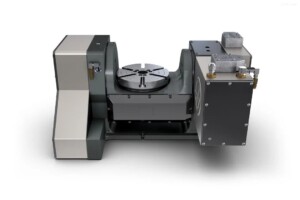
Its primary functions include precise workpiece rotation, indexing and positioning, enabling machine tools to fabricate complex curved surfaces, polyhedrons and high-precision holes. It is widely applied in high-end manufacturing sectors such as aerospace, automotive production, precision molds and military component manufacturing. Conventional machine tools can only perform planar and single-angle machining. By contrast, five-axis machine tools equipped with CNC rotary tables deliver accurate rotation at any angle within 360°, with a positioning precision reaching 0.001 millimeters — roughly one-sixtieth the diameter of a human hair.
Technical challenges mainly lie in four core areas: precision transmission, rigid support, error compensation and numerical control systems. Traditional rotary tables adopt ordinary gear transmission, which suffers from large backlash, rapid precision degradation and short service life. Premium CNC rotary tables generally apply harmonic reducers and cam worm gear pairs, paired with high-precision bearings and closed-loop control systems. This design thoroughly eliminates transmission backlash and sustains stable precision during long-term high-speed operation.
For a long time, the technology of high-precision CNC rotary tables was monopolized by foreign enterprises, putting domestic high-end machine tools in a technological bottleneck. After years of intensive research and development, domestic CNC rotary tables have achieved remarkable breakthroughs. Their indexing accuracy, load capacity and operational stability have all approached world-class standards. This has broken the foreign technological monopoly, greatly cut the procurement costs of high-end machine tools, and freed China’s high-end manufacturing industry from reliance on imported core components.
As an essential part of machine tools — the “mother machines of industry”, technological upgrades of CNC rotary tables directly drive the overall advancement of manufacturing capabilities. From tiny precision parts for mobile phones to aero-engine blades and marine propellers, all rely on the superior precision of CNC rotary tables. It serves as a vivid epitome of China’s manufacturing transformation from rough machining to sophisticated intelligent manufacturing.